
Himalayan Tahr hunting in New Zealand
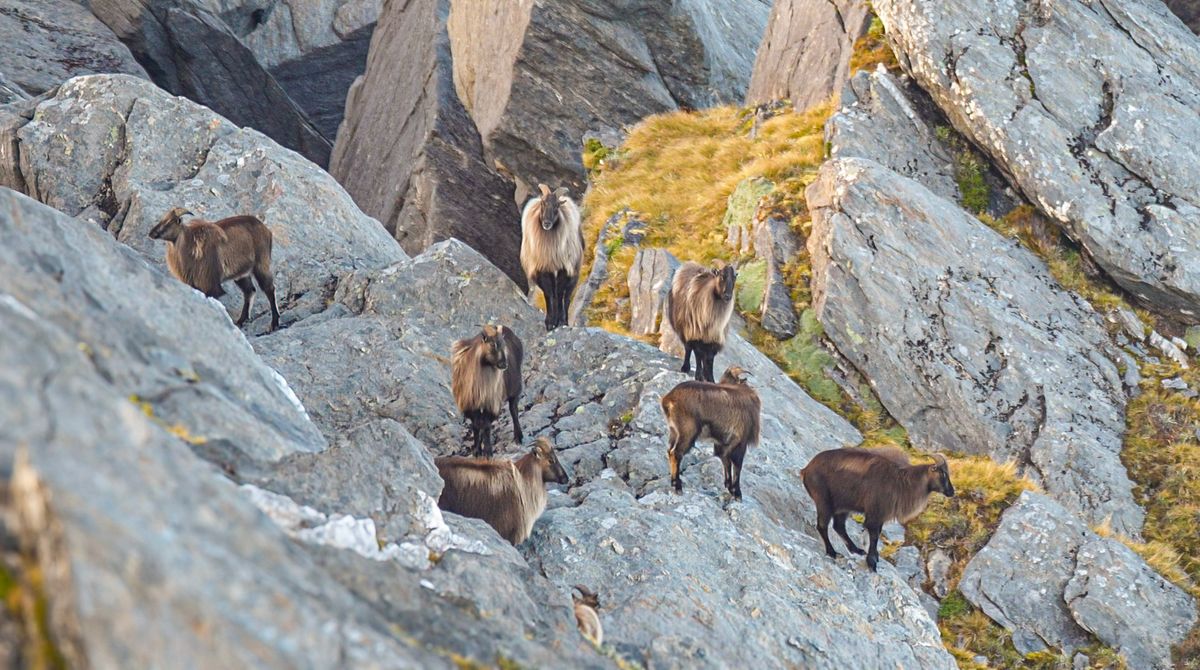
Season Huntable year-round. The rut runs late May to mid-July, when bulls carry their thick winter pelt and full mane.
Tahr are the hunt New Zealand is best known for internationally, and the one that asks the most of a visiting hunter. They live in the steepest country in the Southern Alps, they are hunted through the winter when the weather is worst and the bulls are at their best, and the trophy standard has quietly moved.
Twenty-two of the outfitters in this directory publish a price for a standalone bull tahr hunt. The range runs US$4,500 to US$9,500, with a median of US$6,500.
When to hunt tahr
The rut runs late May to mid-July. That comes from DOC and the Game Animal Council, and it is the answer to the timing question, because the rut and the trophy coincide.
DOC puts it plainly: if you want a bull in the best condition, there is no substitute for the rut. Through it the bulls carry a thick reddish to dark brown pelt with a lighter mane that hangs low on the front leg, and that ruff is a large part of what a tahr trophy actually is.
The animals group up before it. Three separate groups converge around April and May: nannies with kids and juvenile males, mature bulls over four years, and immature bulls of two to three.
Tahr can be legally hunted year-round, and each season asks something different. Winter is the hardest time of year, with the weather and the short days against you. In spring the animals drop to lower and mid altitudes, so there is less climbing, but the bulls have shed and the coat is lighter.
If you want the ruff, come for the rut. Our seasons guide has the full calendar, and tahr pair neatly with chamois, whose rut runs May to July over much of the same country.
One thing to check with your outfitter if you are booking a helicopter-assisted hunt. Aerially assisted trophy hunting runs under DOC permits that close on 31 August, with most blocks opening on 10 February and a handful later in the autumn. As of August 2026 those permits are under review by DOC, covering blocks, fees and conditions. New applications are suspended, and DOC expects to invite them by 30 September 2026 without committing to the date. Operators who gave the required notice may keep working under their existing permits while that is decided, so hunts are not expected to stop, but blocks and fees for 2027 may differ.
Where they live
Tahr occupy a defined legal area called the feral range, covering about 706,000 hectares of public conservation land, Crown pastoral lease and private land in the central Southern Alps.
DOC describes the boundaries two ways on two different pages. One puts the range between about the Rakaia and Whitcombe valleys in the north and about Lake Hawea in the south. The other describes it running from the headwaters of the Rakaia to the Young Range of Otago. Those are the same country described differently, and it is worth knowing that even the official wording varies, because outfitter pages tend to quote whichever version they found.
They were introduced at Aoraki Mount Cook in 1904, a gift from the Duke of Bedford's herd at Woburn Abbey, and everything here descends from animals native to the central Himalaya of India and Nepal.
They are built for ground most animals cannot use. DOC describes hooves combining hard and soft surfaces for grip, and tahr are fast and agile on terrain a hunter has to work at. Bluff country is the preference, and in winter, when snow covers the grassland, tahr and chamois are both pushed onto rock and grass bluffs and shrubland.
That is the practical reason a tahr hunt is what it is. You are hunting an animal that chose the steepest available ground and is better on it than you are.
What a bull looks like
A mature bull stands just over a metre at the shoulder and weighs more than 70 kilograms, with exceptional animals over 130. Nannies seldom exceed 36 kilograms, so a bull is a substantially bigger animal and looks it.
NZDA publishes the most useful field guidance, because judging a bull is genuinely difficult. A mature bull is one and a half to two times the size of a nanny and should look heavy on his feet. Look for a full mane, dark hindquarters and a noticeable dorsal stripe.
And one warning that explains a lot of misjudged trophies: a bull can flare his mane at will, much as a turkey fans its tail. The same animal looks like two different sizes depending on what his ruff is doing.
What counts as a trophy
This is where a tahr hunt differs from most, and it is worth understanding before you are looking at one through a spotter.
Douglas Score is New Zealand's own system, run by the NZ Deerstalkers' Association, who keep the country's records. Horns are measured over the outside curve and around the bases, with the shorter side doubled. No spread measurement is applied.
The benchmark has moved. NZDA's own wording: historically 12 inches on the shortest horn, but in recent years 13 inches has become the benchmark. Their record book opens at 40 Douglas Score or a shortest horn over 13 inches, and competition medals run bronze 44.5, silver 45, gold 45.5.
The New Zealand record is 50½ Douglas Score, a 15⅞ inch bull taken by Peter A. Hogg in the Kakanui Mountains in June 2024, aged ten years.
SCI is the international system, and unlike chamois it runs separate categories for free-range and estate tahr. Free range opens at 37 inches bronze across a little over 1,100 entries, estate at the same bronze minimum across 90. As with chamois, only bronze is a fixed standard: silver and gold are recalculated against the entry pool and drift.
Now the part nobody tells you. We read fourteen New Zealand outfitter pages selling tahr hunts. Four state a horn standard in their own voice. Eight quote no number at all and sell on adjectives. Not one cites a measuring authority, quotes a Douglas or SCI score, or says whether the inches they mention are measured over the curve or straight.
The numbers the market uses are close to NZDA's, which is reassuring, but they come from operators reading each other rather than from a standard. So when a quote says "a 13-inch bull," it is entirely reasonable to ask how that is measured. Any good operator will tell you.
And here is what the inches are worth in money. One operator in this directory publishes a per-inch ladder, which nobody else does: NZ$4,000 for a 12-inch bull, NZ$5,000 at 13, NZ$6,100 at 14, and NZ$8,500 at 15.
Line that up against NZDA and it makes sense. The standard moved from 12 inches to 13, and the market's price step from 12 to 13 is a thousand dollars. From 14 to 15 it is nearly two and a half thousand. That is the clearest answer available to what another inch costs.
The inches are not the whole trophy, though, and guides see this play out. As Bayley puts it, some hunters would rather take a 12-inch bull with a good mane and full coat than a 13-inch bull without one, while others want the horns and nothing else. Both are right. The ladder above prices the horn, but the animal on your wall carries the coat, and which matters more is yours to decide before the hunt, not on the hill.
Worth being realistic about how this works in practice, though. You do not order a 14-inch bull. You hunt what the country holds, your guide judges the animal, and the class is settled afterwards. The ladder tells you what the classes mean, not what you can pick from a menu.
One honest note: DOC publishes nothing at all on tahr size. No weight, no shoulder height, no horn length, no trophy standard. If a page implies a government trophy standard for tahr, it has been invented.
How tahr are hunted
Access is either helicopter or on foot, and that decision drives both the difficulty and the cost.
A helicopter puts you into country that would otherwise take a day or more to reach, and on a short trip it is often the difference between hunting and walking. Going in on foot is cheaper and slower and gets you into country other people have also walked into.
DOC's own hunting guidance is specific and worth following. Sit at a vantage point and glass a wide area, and do not just look once, because animals under cover the first time will show themselves later. Tahr have good hearing, a good nose and excellent eyesight, so use cover and move into the wind.
On the shot, DOC is blunt: a bull tahr is difficult to put down once disturbed or if placement is not perfect, so be ready for a quick follow-up. NZDA recommends a flat-shooting calibre with high striking energy, naming .308, .270, .30-06 or larger, and adds a detail worth remembering, which is to allow for the length of the ridge and mane hair when you place the shot. That ruff is not where you think the animal is.
The daily rhythm matters. Tahr rest through the middle of the day, often among rocky outcrops above the bush line, then move down to feed in the mid to late afternoon.
Bayley, who hunts this country year-round on the West Coast, describes the practical rhythm of it this way. Tahr feed down into the tussock in the evenings, graze that lower country overnight, then slowly feed their way back up through the morning to bed on ridges and rock for the heat of the day. Up high they are safe, looking down at everything approaching from below.
The tactic follows from that. If you are camped in the lower country, get up and try to catch them still down low in the first hour of light. If you miss that window, watch where they park up for the day, get yourself into position, and wait for the evening when they start feeding back down to you. "The best hunting time is their first hour of light and their last hour of light."
Some bulls do the opposite. They live in the scrub just below the tussock line, come up into the open in the mornings and evenings, and duck back off the edge into cover for the middle of the day. A helicopter also shapes where you start: machines land in the lower tussock country, not on the rocky tops, so most hunts begin below the animals rather than among them.
Mobs can be substantial. Bayley describes bull mobs of ten to twenty and nanny mobs of thirty or so, which is one more reason the glassing advice above matters. You are rarely looking for one animal.
Except on the West Coast, where they do the opposite. DOC records that Coast tahr shelter below the bush line rather than above it, then feed upward into tussock and open slips in the evening. If you are hunting the Coast, that reverses the standard advice.
For winter hunting in alpine terrain, DOC recommends good footwear and suggests an ice axe and crampons.
What a tahr hunt costs
From the published rates of twenty-two operators in this directory, gathered July 2026:
- Range: US$4,500 to US$9,500
- Median: US$6,500
Worth noting against chamois. The medians are close, US$6,500 against US$6,000, but the floors are not. Chamois has a public-land entry point around US$2,500. Tahr does not start below US$4,500, because the country is harder to reach.
Helicopter time is the swing, and it is a bigger swing than on any other species. One operator publishes US$4,500 for public land plus US$2,000 per flight hour, against US$6,000 on private land with no flying needed. Others quote US$1,500 to US$3,000 an hour separately. A couple bundle one hour into the package, which is the single easiest thing to compare between two quotes.
Usually included: guide, accommodation, meals, ground transport, airport transfers, field preparation of the trophy and delivery to a taxidermist. Some include rifle hire.
Usually not: helicopter hours, taxidermy, freight and export handling, gratuities, and sometimes GST.
Plus a DOC pass-through. On a helicopter-assisted hunt on public conservation land there is a DOC trophy fee of NZ$150 plus GST per tahr killed and recovered, along with a daily activity fee. Some operators build these in and some bill separately. What a guided New Zealand hunt costs has the wider picture.
Frequently asked questions
- When is the best time to hunt tahr in New Zealand?
The rut runs late May to mid-July, and that is when bulls carry their thick winter pelt and full mane. DOC says there is no substitute for it if you want an animal in best condition. Tahr can be hunted year-round, but the trophy and the rut go together.
- How much does a tahr hunt cost?
Twenty-two operators in this directory publish a price, ranging US$4,500 to US$9,500 with a median of US$6,500. The biggest variable is helicopter time, which can add US$1,500 to US$3,000 an hour. Add a DOC trophy fee of NZ$150 plus GST per recovered animal on helicopter-assisted hunts on public land.
- What is a good tahr trophy?
NZDA, who keep New Zealand's records, say 12 inches on the shortest horn was the historic benchmark and 13 inches has become the modern one. The record book opens at 40 Douglas Score or over 13 inches. The national record is 50½ Douglas Score, a 15⅞ inch bull taken in 2024.
- Are tahr hunted free range or on estates?
Both, though free range is far more common. SCI maintains separate record categories and lists more than a thousand free-range entries against ninety estate ones. Most tahr hunting happens on public conservation land or large unfenced private blocks in the Southern Alps.
- How fit do I need to be to hunt tahr?
This is the most physically demanding hunting in New Zealand. A helicopter-supported hunt asks considerably less than a walk-in one, because the machine removes the approach, but you are still climbing and descending steep ground once you are there. Our fitness guide breaks down the range.
- Can I hunt tahr and chamois on the same trip?
Yes, and it is the most common combination in the country. Both ruts overlap through June, and they share much of the same range, though they often use different parts of it. Expect them to be hunted on separate days.
- Do I need a licence to hunt tahr?
There is no hunting licence in New Zealand. On public conservation land you need a free DOC permit, which your outfitter arranges. Firearms are separate: if you shoot under your guide's immediate supervision you do not need a firearms licence of your own, but bringing your own rifle still requires a permit to import. For most visitors the simplest route is the visitor firearms licence, which covers both, and the Firearms Safety Authority asks you to apply at least four months before you travel. Our visitor firearms licence guide has the detail.
Sources: Rut, coat condition, feral range, hunting method and terrain from the Department of Conservation. Body size from the New Zealand Game Animal Council and the New Zealand Deerstalkers' Association. Trophy standards, measuring method, records and field judging from NZDA. International trophy categories from Safari Club International. Winter habitat use from Forsyth, 2000. AATH permit conditions, trophy fee and season window from the Department of Conservation's published AATH permit template and concession pages. Price range and median compiled from the published rates of 22 outfitters listed in this directory, gathered July 2026. Accurate to the best of our knowledge as of August 2026.