Chamois hunting in New Zealand
Season Huntable year-round; April–July offers prime capes and cooler stalking conditions.
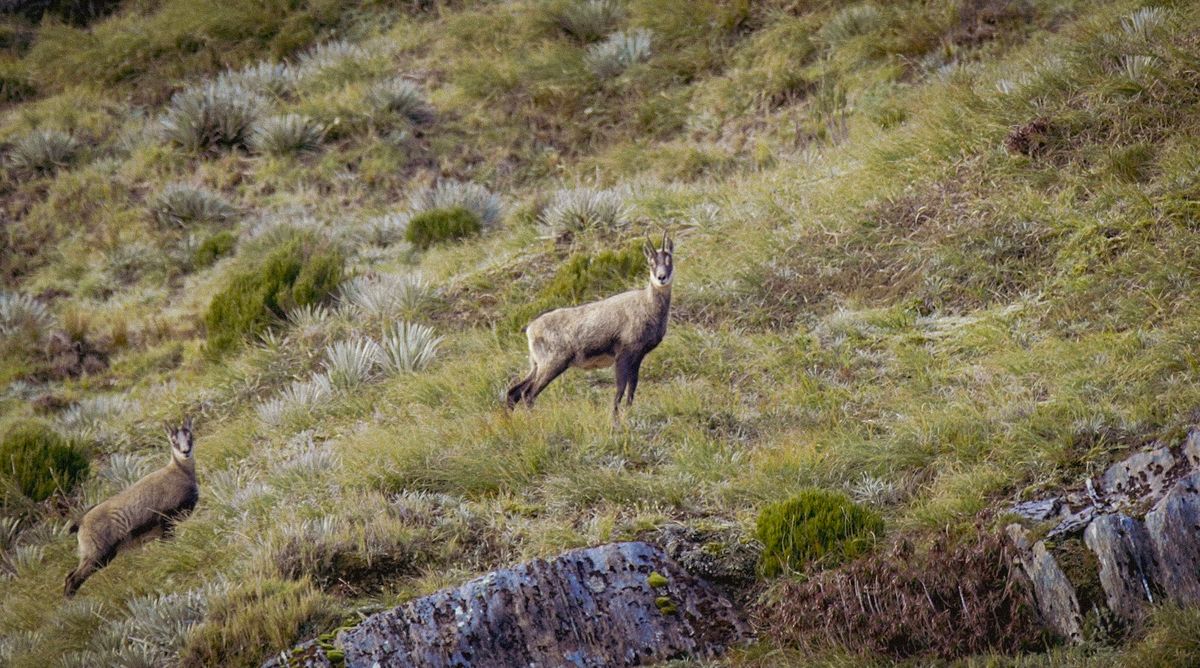
Chamois are the alpine hunt most visiting hunters have never considered and the one a lot of them enjoy most. They range wider across the South Island than any other introduced game animal here, they are hunted year-round with no closed season, and a chamois hunt is the cheapest way into serious New Zealand mountain country.
Eighteen of the outfitters in this directory publish a price for a standalone chamois hunt. The range runs from US$2,500 to US$9,500, with a median of US$6,000.
When to hunt chamois
The rut runs May, June and July, according to the Game Animal Council, with DOC putting the peak at late May to early June. Bucks are more active and less careful during it, which is why most guided chamois hunts are booked in that window.
There is no closed season. You can hunt chamois legally at any time of year, and plenty of operators will take you outside the rut. What changes is behaviour rather than legality: outside the rut the animals are harder to find and less inclined to make a mistake.
If you are combining chamois with tahr, the two overlap neatly. Tahr hunting is at its best from late May to mid-July, so a single trip in June covers both. Our seasons guide has the full calendar.
Where they live
Chamois range further than most people expect. DOC puts them from the Marlborough Sounds in the north to Fiordland in the south, which is most of the length of the South Island.
They are also less strictly alpine than tahr. Chamois come down into Westland forest, in places right to sea level, and they use a wider spread of country than any other game animal we list. The only detailed study measuring both species side by side, Forsyth in 2000, found tahr use bluff country more than chamois do. DOC puts the practical version more simply: chamois will often avoid areas where tahr are feeding.
For a hunter that has two practical consequences. Chamois country is often more accessible than tahr country, which is part of why the hunt costs less. And where the two species share a range, your guide is likely to hunt them in different places on different days rather than expecting both off one face.
They were introduced in 1907, a gift from Austria, released near Aoraki. Everything in New Zealand descends from that release.
What counts as a trophy
New Zealand has its own measurement system and it is the one to understand first.
Douglas Score is used by the New Zealand Deerstalkers' Association, which keeps the country's official big game records. NZDA's published figures:
- A representative mature trophy is 9 to 9½ inches on the shortest horn
- The record book opens at 27 Douglas Score, or a shortest horn over 10 inches
- Competition medals run bronze at 28, silver at 28.5, gold at 29
SCI is the system the international safari trade uses, and its "Chamois, South Pacific" category has a bronze minimum of 20 inches across a little over a thousand entries. One caveat comes straight from SCI's own measuring manual: only bronze is a fixed standard. Silver and gold are recalculated as proportions of the entry pool, so those numbers move over time.
Two things worth knowing because the market tends to blur them.
Neither system measures spread. Both are horn length plus base circumference. If you see a chamois advertised on its spread, that tells you something about the seller.
Neither system separates the sexes. This surprises people. New Zealand's record chamois is a nanny, 31 1/8 Douglas Score, taken in the Styx Valley in 1968, and the longest horns ever reported here, 13¼ inches, were also a female's. A larger buck exists on paper at 32 2/8 but NZDA notes it is suspected of having been helicopter-assisted, which is why it does not stand.
The horns are the trophy, full stop. Bucks grow a dorsal crest along the back in the rut, and it can look striking, but as Bayley notes, it is not classed as a trophy feature the way a tahr's mane is. Chamois are judged on horn, which is why the measuring systems above are the whole conversation.
One honest note: neither DOC nor the Game Animal Council publishes any chamois size or trophy figures. If you find a page implying a government trophy standard for chamois, it has been invented.
How chamois are hunted
Chamois are hunted free range. There is no such thing as an estate chamois hunt in New Zealand, because they live in open alpine and bush country that is not enclosed. If you are coming for chamois you are hunting wild animals on wild ground, whether or not anybody uses the word.
What does vary is whose land you are on. Some chamois country is public conservation land and some is private station country, and operators price the two differently. Private land is not the same as an estate: one operator in this directory describes both its public and its private chamois options as free-range genuine hunting. What private access usually buys is easier ground and less flying, which is why it is sometimes the dearer of the two rather than the cheaper.
Access is either on foot or by helicopter. On foot means a walk in, and depending on the block that can be a day's work before the hunting starts. A helicopter puts you on top of country you could not otherwise reach, and that decision is the single biggest variable in what a chamois hunt costs.
DOC's own guidance on hunting them is the most useful method advice published for any species we cover, and it comes down to this: glass well ahead of yourself, approach from above where you can, and remember they habitually watch downhill. A chamois that has not seen you is a very different animal from one that has.
Bayley, who hunts both species year-round on the West Coast, adds two things a first-timer will not know. Chamois do not mob up the way tahr and deer do. Where a tahr face might carry twenty bulls, a chamois sighting is typically one buck with two or three does, and a group of ten is rare. You are hunting individuals, not herds.
And their daily movement tends to run opposite to tahr. Chamois more commonly live in the lower country and feed upward, where tahr live high and feed down, though he is quick to say both patterns exist in both species. The two can be on the same face within sight of each other, but they do not travel together, which is why a combined trip hunts them on separate days.
What a chamois hunt costs
From the published rates of eighteen operators in this directory, gathered July 2026:
- Range: US$2,500 to US$9,500
- Median: US$6,000
The spread is wide because it is largely a question of how you get there. Helicopter time is the most consistent exclusion in the market, and one operator publishes the comparison cleanly: US$2,500 for a public land hunt plus US$2,000 per helicopter hour, against US$4,000 on private land where no helicopter is needed. Another shows US$3,500 with the flying excluded against US$6,000 with it included.
So when you compare two chamois quotes, the first question is whether flying is in the number.
Usually included: your guide, accommodation, meals, ground transport, airport transfers, field preparation of the trophy and delivery to a taxidermist.
Usually not: helicopter hours, the taxidermy itself, freight and export handling, gratuities, and sometimes GST.
Plus a DOC pass-through. On a helicopter-assisted hunt on public conservation land there is a DOC trophy fee of NZ$100 plus GST per chamois killed and recovered. Some operators build it in and some bill it separately. What a guided New Zealand hunt costs covers the wider picture.
One responsibility worth knowing about
The Game Animal Council asks hunters in the alps to think about kea. Chamois carcasses are a food source for them, and lead from bullets is the risk. If you are hunting chamois country, it is worth asking your guide what he does about gut piles and whether he uses non-lead ammunition.
It is a small thing and it is the sort of question a good operator will be pleased you asked.
Sources: Rut timing from the New Zealand Game Animal Council; peak and hunting method from the Department of Conservation. National range from DOC. Habitat comparison with tahr from Forsyth, 2000. Trophy standards from the New Zealand Deerstalkers' Association (Douglas Score) and Safari Club International (South Pacific chamois). DOC trophy fee from the Department of Conservation's published AATH permit template. Kea guidance from the Game Animal Council. Price range and median compiled from the published rates of 18 outfitters listed in this directory, gathered July 2026. Accurate to the best of our knowledge as of August 2026.
Frequently asked questions
- When is the best time to hunt chamois in New Zealand?
The rut runs May, June and July, peaking late May to early June, and that is when most guided hunts are booked. There is no closed season, so chamois can be hunted year-round, but they are harder to find outside the rut.
- How much does a chamois hunt cost?
Eighteen operators in this directory publish a price, ranging from US$2,500 to US$9,500 with a median of US$6,000. The biggest variable is whether helicopter access is included. Add a DOC trophy fee of NZ$100 plus GST on a recovered animal for helicopter-assisted hunts on public land.
- What is a good chamois trophy?
NZDA, which keeps New Zealand's official records, puts a representative mature trophy at 9 to 9½ inches on the shortest horn. The record book opens at 27 Douglas Score. In SCI terms, bronze starts at 20 inches.
- Are chamois hunted free range or on estates?
Free range only. Chamois live in open alpine and bush country that is not enclosed, so every chamois hunt in New Zealand is a wild animal on wild ground. Some hunts are on public conservation land and some on private stations, but private land here means access and easier ground, not a fence.
- Can you hunt chamois and tahr on the same trip?
Yes, and it is a common combination. Both are at their best from late May through July, and many operators offer them together. They often live in different parts of the same range, so expect them to be hunted on separate days.
- Do I need a licence to hunt chamois?
No hunting licence exists in New Zealand. On public conservation land you need a free DOC permit, which your outfitter arranges. Firearms are separate: if you shoot under your guide's immediate supervision you do not need a firearms licence of your own, but bringing your own rifle still requires a permit to import. For most visitors the simplest route is the visitor firearms licence, which covers both, and the Firearms Safety Authority asks you to apply at least four months before you travel. Our visitor firearms licence guide has the detail.
- How fit do I need to be?
Chamois country is genuinely steep, though often more accessible than tahr country. A helicopter-supported hunt asks considerably less than a walk-in one. Our fitness guide breaks down what each end of the range involves.