
How Red Stags Are Scored in New Zealand: SCI, Douglas Score and Medal Classes
Contents
A red stag is scored by measuring its antlers in inches and adding the numbers up. New Zealand outfitters price by the SCI (Safari Club International) system, which counts both main beams, every tine, three circumferences on each side and the inside span. That total is the SCI score, and on most red stag price lists it decides what you pay.
New Zealand also has its own system, the Douglas Score. Rowland Ward, the world record book, takes some New Zealand animals too. Boone and Crockett and Pope and Young don't take any.
| System | Run by | What it's used for | Scores New Zealand animals? |
|---|---|---|---|
| SCI | Safari Club International | Outfitter price lists, the SCI Record Book | Yes, free-range and estate |
| Douglas Score | New Zealand Deerstalkers' Association (NZDA) | New Zealand records and NZDA competitions | Yes, New Zealand species only |
| Rowland Ward | Rowland Ward | World record book | Yes, free-range only |
| Boone and Crockett, Pope and Young | US clubs | North American records | No |
How do you score a red stag with SCI?
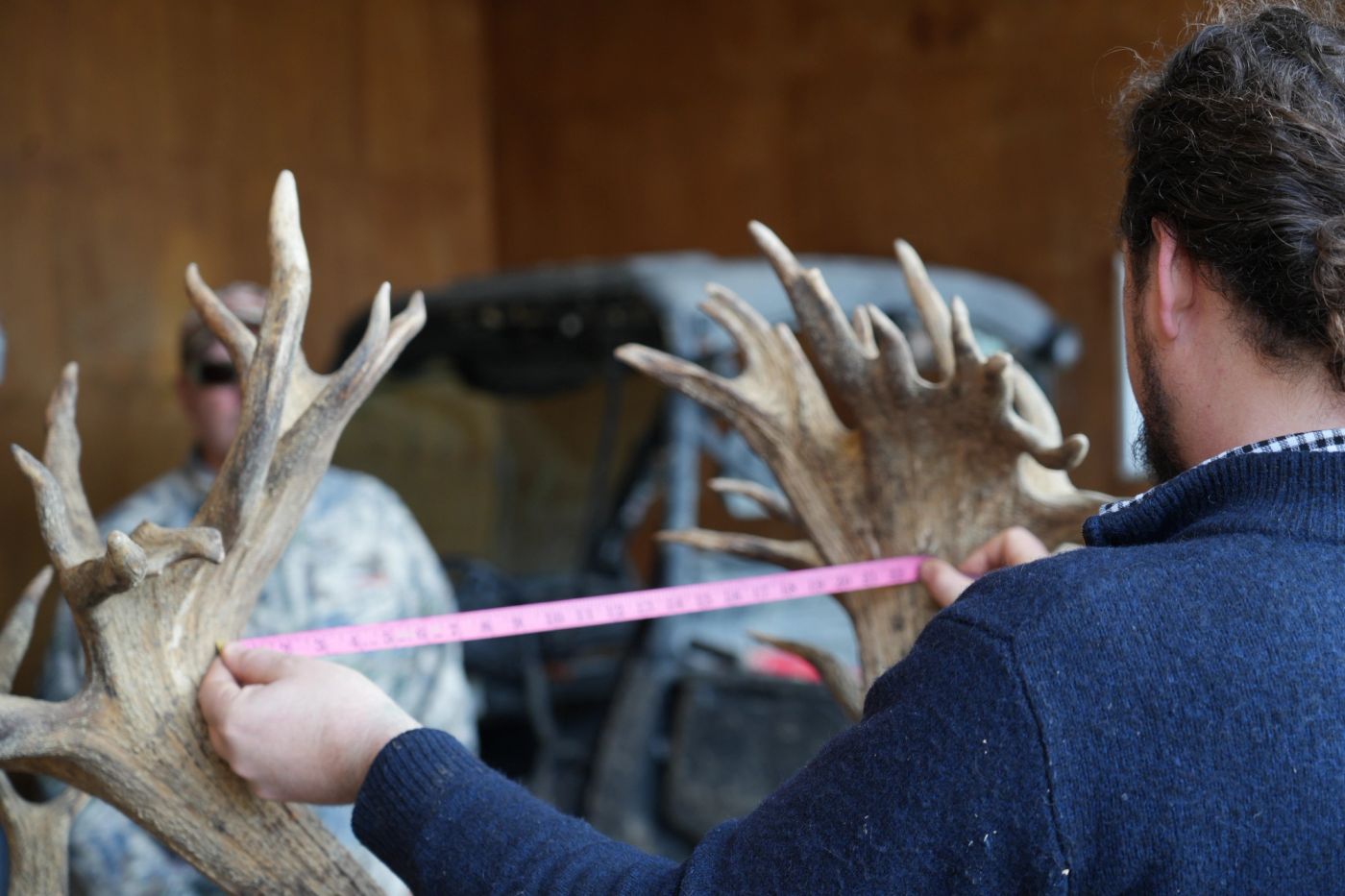
SCI measures red deer under its Method 20 (SCI Measuring Manual), in inches to the nearest eighth. The measurer adds up:
- the length of each main beam, from the burr (the ring at the base of the antler) to the tip
- the length of every tine on both antlers, typical or not
- the circumference of each burr
- two circumferences on each main beam
- the inside span between the main beams
SCI doesn't split red deer into typical and non-typical, so every tine counts. Nothing comes off for one antler being different from the other. The only deduction is 2% for antlers still in velvet. The number of points goes on the score sheet, but it isn't part of the score.
So under SCI, a big, uneven stag with lots of extra tines does well. Nothing is taken away for the mess.
Tahr and chamois are scored with SCI's horn method: the length of each horn plus the circumference of each horn at the base, all added together. Fallow have their own method, Method 24.
Why does the score set the price?
Most outfitters sell a red stag by SCI class, and the price goes up with each class. Our red stag cost page shows published prices for each 50-point band, from 300 to 349 up to 400 to 449, so you can see what a 300-class or a 400-class stag runs to. You pay for the class the animal measures into, usually settled at the end of the hunt. The costs article covers what a step up a class usually adds.
Fallow are sometimes priced by SCI score as well; see the fallow cost page. Tahr and chamois are mostly sold for one trophy fee. Fewer than three outfitters publish score bands for either, so the tahr and chamois cost pages show none.
What do bronze, silver and gold mean?
Depends who's saying it. There are three meanings, and they don't line up.
On an outfitter's price list, bronze, silver and gold are that outfitter's own classes. Each sets its own lines. One published ladder calls 370 to 400 SCI gold. SCI's own gold medal for a free-range South Pacific red stag starts at 287 7/8. Same word, very different stag. Ask for the outfitter's whole class ladder in writing, with the score range for each class.
In the SCI Record Book, bronze, silver and gold are medallion levels. Bronze is the Record Book minimum for that animal. Silver and gold are worked out by computer so that a third of the entries in each category are gold, a third silver and a third bronze. That means the gold line moves as new entries come in.
These were the levels on SCI's online record book on 11 October 2026, for its South Pacific categories, which cover New Zealand and Australia:
| Animal (SCI South Pacific) | Category | Bronze | Silver | Gold |
|---|---|---|---|---|
| Red deer | Free range | 185 | 246 5/8 | 287 7/8 |
| Red deer | Other | 190 | 319 3/8 | 390 5/8 |
| Wapiti (elk), typical | 250 | 327 | 368 | |
| Wapiti (elk), non-typical | 260 | 348 7/8 | 392 7/8 | |
| Fallow deer | Free range | 150 | 188 5/8 | 211 5/8 |
| Fallow deer | Other | 153 | 204 | 232 |
| Sika deer, typical | Free range | 108 | 119 6/8 | 133 3/8 |
| Sika deer, typical | Other | 90 | 126 | 139 1/8 |
| Himalayan tahr | Free range | 37 | 40 4/8 | 42 6/8 |
| Himalayan tahr | Other | 37 | 41 | 44 |
| Chamois | All | 20 | 24 5/8 | 26 |
"Other": SCI's site lists a second category for these species without labelling it. For fallow and sika, its bronze level matches the estate minimum in SCI's measuring manual, so it's most likely the estate list. SCI files any animal taken inside a fence in its estate category.
For how wapiti are hunted and priced in New Zealand, see the wapiti (elk) page.
In NZDA competitions, gold, silver and bronze are fixed Douglas Score standards, covered below.
What is the Douglas Score?
The Douglas Score is New Zealand's own system. Norman Douglas devised it in the 1940s, and the NZDA adopted it in 1958. It applies only to New Zealand's big game species, and the NZDA keeps the official New Zealand records with it.
The big difference from SCI is that the Douglas Score rewards a matched pair. Each measurement is taken on both antlers, the shorter one is doubled, and the totals are added. So an uneven head scores as twice its weaker side. The stag that does well under SCI for its extra tines can come out ordinary on a Douglas Score. Spread and span go through a ratio table to give a spread factor. Horns are measured along the outside curve and around the base, with no spread for tahr or chamois. Measurements are in inches and eighths.
A Douglas Score and an SCI score are different numbers for the same head. Check which one you're looking at before you compare two prices.
| SCI | Douglas Score | |
|---|---|---|
| Used for | Outfitter price lists, SCI Record Book | NZDA records and competitions |
| Uneven antlers | Everything is added, nothing taken off | Shorter side doubled, so symmetry counts |
| Spread | Inside span added | Spread and span turned into a spread factor |
| Species | Worldwide | New Zealand species only |
| Units | Inches and eighths | Inches and eighths |
These are the NZDA's published standards:
| Species | NZDA record book minimum | NZDA bronze | NZDA silver | NZDA gold |
|---|---|---|---|---|
| Red deer | 300 | 320 | 335 | 350 |
| Wapiti, elk or Fiordland deer | 380 | 320 | 340 | 360 |
| Fallow deer | 200 | 230 | 240 | 250 |
| Sika deer | 170 | 185 | 195 | 205 |
| Himalayan tahr | 40, or over 13 inches long | 44.5 | 45 | 45.5 |
| Chamois | 27, or over 10 inches long | 28 | 28.5 | 29 |
The medal standards are for the NZDA's national Antler, Horn and Tusk competition, and the judges have to agree unanimously before a medal is given. That competition is for NZDA members, and a head isn't eligible if a trophy fee was paid, if it was taken behind a deer fence, or if it was shot from an aircraft. So a guided hunter's stag can be Douglas scored, but it can't win an NZDA medal.
Do Boone and Crockett or Pope and Young score New Zealand animals?
No. The Boone and Crockett Club keeps the records of North American big game, and only native, wild, free-ranging big game is eligible. Pope and Young keeps bowhunting records for North American big game species. New Zealand's deer, tahr and chamois are all introduced, and none of them is taken in North America. New Zealanders call elk wapiti, and a New Zealand wapiti can't go in either book.
If you bowhunt, SCI keeps bow minimums alongside its rifle minimums. Read more in bow hunting in New Zealand.
Does Rowland Ward record New Zealand trophies?
Yes, but only free-range animals. Rowland Ward accepts entries from game-proof fences in Africa and Europe only, so an animal from a fenced New Zealand estate can't go in.
Its minimums for introduced South Pacific game, for the 31st edition:
| Species | Rowland Ward minimum |
|---|---|
| Red deer | 250 |
| Wapiti or elk | 340 |
| Fallow deer | 130 |
| Sika deer | 125 |
| Himalayan tahr | 12 4/8 inches (32 cm), longest horn |
| Chamois | 9 inches (23 cm), longest horn |
Tahr and chamois are ranked on the longest horn, not a total score. Rowland Ward requires a 60-day drying period before measuring.
Who measures the trophy, and when?
For price, it's normally measured at the end of the hunt, while the antlers are still fresh. That's a green score. SCI allows most animals to be measured green, by one of its two levels of measurer: Official or Master.
The exception is a very big animal. Anything that would rank in the overall top 20 of an SCI category has to be measured again by a Master Measurer at least 60 days after it was taken, without being frozen in the meantime. A red deer that would rank in the overall top 10 also needs a live video panel score. To enter the SCI Record Book at all, you have to be an SCI member when you enter, though not when you hunt.
The wait is there because antlers and horns can shrink as they dry. A dry score can come in under the green score you paid on.
Questions to ask the outfitter before you book:
- Which system are your prices in, SCI or Douglas?
- What score range is each of your classes?
- Who measures the animal for billing, and are they an SCI Official or Master Measurer?
- Is the fee set on the green score on the day?
- If I want it in the SCI Record Book, who measures it after the drying period?
If you're planning a heli hunt, ask how the helicopter is used. SCI's manual says animals "shot from or driven by helicopter" are not accepted into its Record Book. The helicopter hunting article explains how heli hunts work in New Zealand. For getting the trophy home after it's measured, see trophy export to the USA.
Quick answers
How do you score a red stag? Under SCI, the system New Zealand outfitters use, you add up the length of both main beams, every tine, three circumferences on each side and the inside span, in inches. Under New Zealand's Douglas Score, the shorter side of each measurement is doubled, so symmetry counts.
What is a gold medal red stag? Depends who's saying it. An outfitter's "gold" is its own price class: one published ladder puts it at 370 to 400 SCI. SCI's own gold medallion is the top third of its record book entries, which was 287 7/8 for free-range South Pacific red deer on 11 October 2026.
What is considered a trophy red stag? There's no single line. SCI's record book minimum for South Pacific red deer is 185, and the NZDA record book starts at a Douglas Score of 300. On a price list, the trophy is whatever class you book.
Does Boone and Crockett score red stag? No. Boone and Crockett only records native, wild, free-ranging North American big game. Red stags from New Zealand are scored by SCI, the Douglas Score or Rowland Ward.
What is the difference between SCI and the Douglas Score? SCI adds every measurement and doesn't deduct for an uneven head. The Douglas Score doubles the shorter side of each measurement, so it rewards symmetry, and it only covers New Zealand species.
When is a trophy officially measured? For price, the outfitter measures it green, usually at the end of the hunt before you settle up. For a top 20 SCI Record Book entry, or for Rowland Ward, after a 60-day drying period.
Sources: SCI Measuring Manual, September 2023; SCI Online Record Book: Red Deer, South Pacific; SCI: Wapiti; SCI: European Fallow Deer, South Pacific; SCI: Sika Deer, South Pacific; SCI: Himalayan Tahr, South Pacific; SCI: Chamois, South Pacific; NZDA: Trophy Scoring, Douglas Score; NZDA: Antler, Horn and Tusk Competitions; NZDA: AHT 2026 entry form; NZDA: National Competition Rules; NZDA: The History of the Douglas Score; Rowland Ward: Europe, Asia and South Pacific minimums; Rowland Ward: Fenced Game Populations; Rowland Ward: Method 7-b form; Boone and Crockett Club reaffirms standards for wild, free-ranging game (via HuntingLife, 15 Jan 2026); Pope and Young: Entry Requirements.